the first 1,000 users did not come from launch day
I did not build LearnSol because a clever growth plan was waiting in a notes application. I built it because learning Solana was more confusing than I thought it needed to be. Documentation was scattered, explanations often assumed that the reader had crossed half the bridge, and beginners were handed roadmaps when many of them needed one obvious place to put a foot.
The problem was clear. Distribution was not.
Launching a product is usually described as though the button is the difficult part. Before launch, one can stay occupied with code, copy, colours, and the reassuring fiction that the right finishing touch will make people arrive. Pressing the button removes that fiction. One sits on the other side with a useful product, a clean page, months of small decisions, and the discovery that nobody is obliged to care.
This is obvious, but only in the abstract. It feels rather different when the silent analytics belong to you.
Before LearnSol existed, I had been sharing what I was learning about Solana: Rust mistakes, small wins, questions I could not answer, things that clicked five minutes later, and the occasional meme after I had exhausted the intelligent material.
I was not executing a personal-brand strategy, at least not in the loud and vaguely embarrassing sense in which that phrase is often used. I was leaving a public trail of the work. By the time LearnSol had something worth showing, a few people already understood the problem because they had watched me encounter it. The product had a name only later; the problem had been visible for some time.
Thus, the launch had somewhere to land. LearnSol found its first users because I had talked about the problem before the product existed, continued talking after the launch had gone quiet, and gave beginners something useful when they arrived. There was no launch-day miracle, growth hack, or especially attractive flywheel diagram.
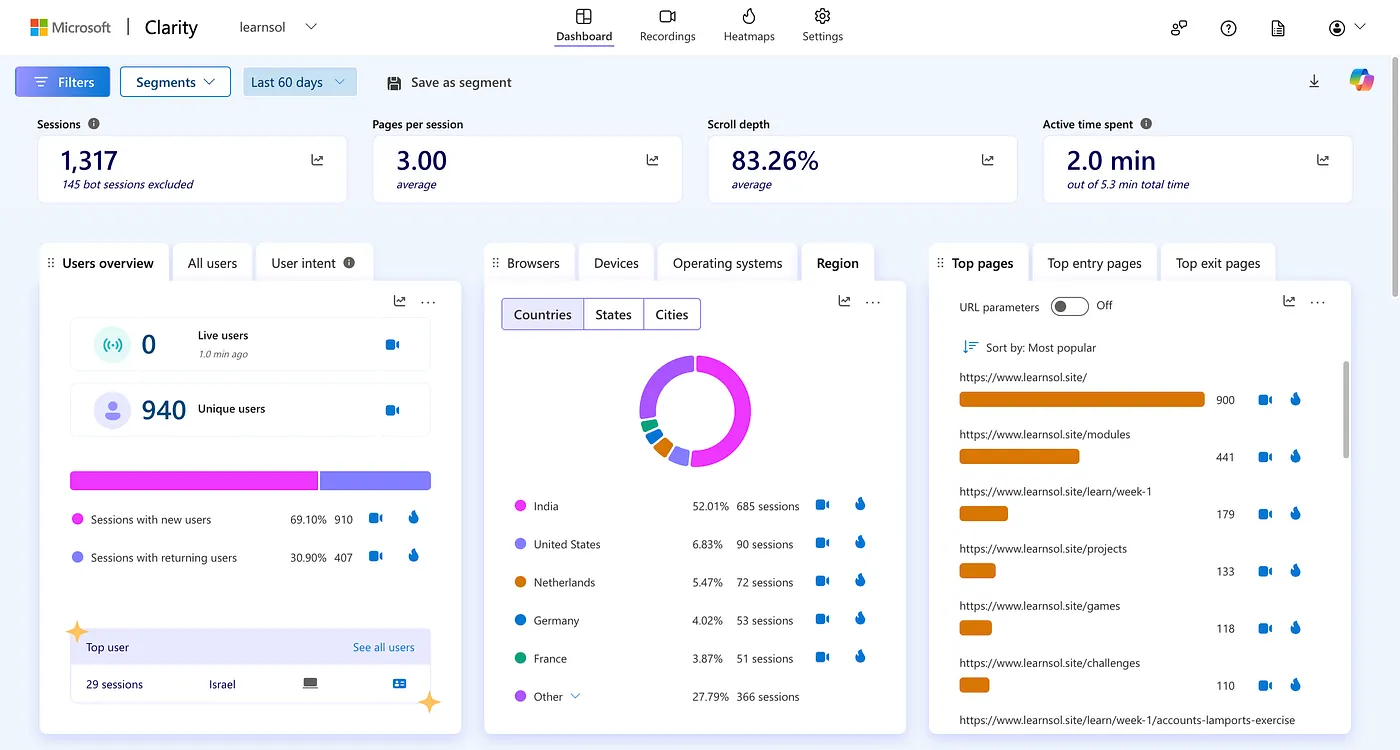
Between October 7, 2025 and August 9, 2026, Microsoft Clarity recorded 3,225 sessions from 2,193 unique users on LearnSol. Of those sessions, 493 were bots, a useful reminder that an analytics dashboard will happily turn automated traffic into personal achievement if allowed. There were 170 sessions with a sign-up event. Google sent 560 sessions and t.co sent 510.
I do not know how many of those people changed their lives, became Solana engineers, or even liked the site. The numbers establish the more modest and useful fact that LearnSol had travelled beyond my laptop.
The first posts after launch did not cause the internet to stand up and applaud. I shared the product, then a module, a bug, a screenshot, something a user tried, and another change. It was repetitive because most real work is repetitive.
There is a peculiar belief that one announces a product and receives an audience, like requesting an item from a vending machine. When this fails, as it usually does, the temptation is to check analytics twelve times and interpret a quiet first day as a verdict. Silence makes public work feel foolish. One has built the stall, arranged everything carefully, and watched people walk past it.
Sometimes they walk past because the product is bad. Sometimes the message is bad. Sometimes the people who would care have not seen it because they were offered one opportunity to notice, after which the maker disappeared to protect their ego. A quiet day does not distinguish between these possibilities.
I kept talking.
LearnSol also kept changing. New pages and challenges gave people reasons to return, and the path through the material became clearer. Modules accounted for 661 sessions, challenges for 653, and the Rust challenge path for 394. People were not merely arriving at the home page; they were looking for the next thing.
That was the signal I cared about.
Distribution can put a person in front of a product. It cannot make a confusing product useful. A post cannot explain Solana's accounts model on behalf of the page it links to. When the next step is vague, people leave. When progress requires fourteen open tabs, they leave with considerable justification.
While building LearnSol, I kept returning to one question: if someone arrives knowing almost nothing, what can they do in the next five minutes that leaves them less lost?
That question shaped the product more than the growth advice I encountered. Give the visitor an obvious beginning, a small thing to try, evidence that they have made progress, and then a visible next step. The average session reached 2.29 pages and the average scroll depth was 77.67%. Neither number certifies comprehension. They do suggest that visitors spent more than ten seconds deciding the site was irrelevant.
It is tempting to redraw this experience as a loop: share the work, acquire users, improve the product, acquire more users. Put four arrows around it and one has a growth strategy suitable for a slide deck. From inside the loop, it was less elegant. I was tired, unsure whether the next post would matter, and often fixing a small problem while wondering whether a larger one deserved the time. Consistency sounds admirable at noon and more like a clerical obligation at 11 PM, when nobody requested any of this.
And yet, that is where the accumulation occurred. I showed the work before launch, continued after launch, and tried to ensure that there was something useful behind the attention when it arrived.
For LearnSol, reaching the first thousand users was not one event. It was a sequence of small public acts and small product improvements, many of which appeared to do very little on the day. I still had to make a place worth visiting, but I also had to keep pointing to the door.